

Lithium Market to Grow from USD 10,840 Million in 2026 to USD 47,340 Million by 2035 at 17.8% CAGR
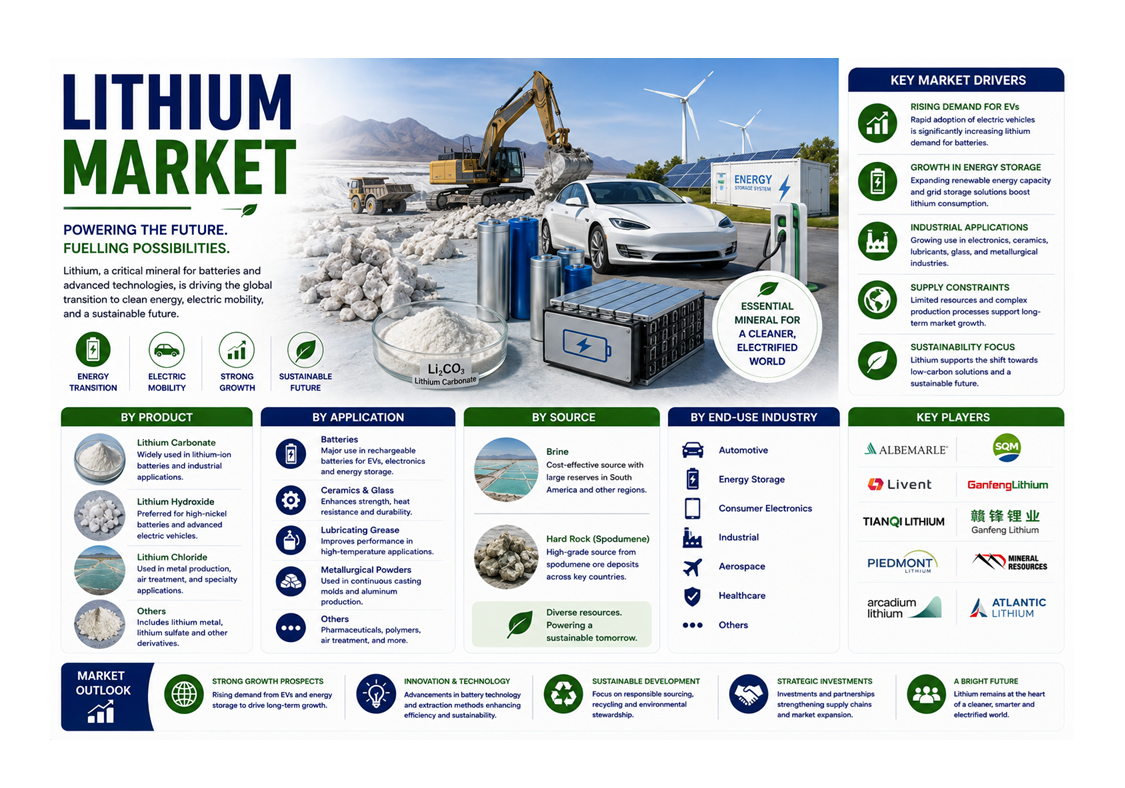
Lithium Market (2026 - 2035)
North America is the fastest-growing region at a 23.8% CAGR through 2035.
Asia-Pacific dominated the Lithium Market with a 60.5% share in 2025.
”
BRAZIL, AUSTRALIA, August 11, 2026 /EINPresswire.com/ -- The according to Market Research Future analysis Lithium Market reached an estimated USD 9,200 Million in 2025 and is projected to grow from USD 10,840 Million in 2026 to USD 47,340 Million by 2035, registering a compound annual growth rate of 17.8% across the forecast period.This trajectory is being driven by a convergence of regulatory mandates, technological breakthroughs, and supply-chain realignments that are fundamentally reshaping how the world sources, processes, and consumes the critical mineral that powers the energy transition.— Energy Gov
Policy and Technology: The Twin Engines of Demand
Two policy frameworks are actively reshaping the competitive landscape. The European Union's "Fit for 55" package requires new passenger cars to achieve zero tailpipe emissions by 2035, effectively mandating full battery-electric fleets across 27 member states. China's dual-credit policy has driven new-energy-vehicle penetration past 38% in 2024. The U.S. Environmental Protection Agency's multi-pollutant rule projects 56% battery-electric vehicle share of new light-duty sales by 2032. Together, these overlapping mandates create a demand floor for lithium that insulates consumption from short-term price volatility.
On the supply side, the U.S. Inflation Reduction Act channels over $7.1 billion in tax credits toward qualified domestic mineral processing through Section 45X advanced manufacturing production credits. The EU Critical Raw Materials Act targets 40% of processing within Europe by 2030. These policies are pulling raw-material supply chains closer to end-market demand and accelerating mine-to-cathode investments across North America and Europe.
The underlying technology transformation centers on replacing conventional nickel-manganese-cobalt cathode chemistries with lithium-iron-phosphate and high-nickel formulations that shift the bottleneck decisively toward lithium feedstock. Battery-pack costs dropped below the $110 per kilowatt-hour threshold in 2025, triggering a wave of multi-year offtake agreements between automakers and upstream producers.
Request Free Sample Copy with TOC: https://www.marketresearchfuture.com/sample_request/8030
Market Size and Forecast Trajectory
Market Research Future's proprietary estimation framework integrates upstream mine output data, midstream refining-capacity trackers, downstream cell-manufacturing procurement disclosures, and regulatory filings across 42 countries. The market has grown from $5.8 billion in 2021 and is expected to reach $15.04 billion by 2028 before accelerating toward the $47.34 billion endpoint in 2035.
Segment Analysis by Compound
Lithium carbonate remains the workhorse of the market, accounting for roughly 69% of total volume in 2025. Its dominance is driven by the global proliferation of lithium-iron-phosphate cells, which now account for over 40% of EV battery installations worldwide. Chinese cell manufacturers have standardized around carbonate-based precursors, creating a self-reinforcing demand cycle tied to the world's largest electric vehicle market.
Lithium hydroxide is the fastest-growing compound segment, forecast to expand at a 21.2% CAGR through 2035. This reflects the transition toward high-nickel cathode chemistries as Western and South Korean cell producers scale formulations for premium vehicles requiring energy densities above 250 watt-hours per kilogram. Automakers such as BMW and Mercedes-Benz have structured hydroxide-specific offtake agreements extending beyond 2030, locking in supply at formula-based pricing linked to spodumene concentrate indices.
Lithium chloride and other compounds combined represented less than 8% of total volume in 2025, serving niche pharmaceutical and metallurgical applications valued at approximately $310 million.
Segment Analysis by Application
The battery application overwhelmingly dominates the lithium market, capturing approximately 73.5% of total share in 2025. Cell demand spans three reinforcing verticals: automotive propulsion, stationary grid storage, and portable electronics. As pack-level costs continue declining, second-life battery deployments and behind-the-meter commercial installations create additional pull on primary lithium procurement.
Lubricants and grease applications contributed approximately $680 million in 2025, serving industrial machinery and aerospace greases where lithium-based soaps remain the thickener of choice. Air treatment is growing at a 13.4% CAGR, driven by HVAC absorption chillers and carbon dioxide scrubbing applications. Other applications, including continuous casting and polymer catalysis, contributed approximately $295 million.
Buy Now: https://www.marketresearchfuture.com/checkout?currency=one_user-USD&report_id=8030
Segment Analysis by End-User Industry
The automotive sector is the largest end-user industry, holding around 47% of market revenue in 2025. This reflects the industry's accelerating shift from internal-combustion powertrains to full-electric architectures across passenger, commercial, and two-wheeler categories. The International Energy Agency projects global EV sales will surpass 45 million units annually by 2030, requiring approximately 2.5 million tonnes of lithium carbonate equivalent, nearly double 2025 consumption levels.
Energy storage is the fastest-growing end-user segment, advancing at a 22.4% CAGR. Regulatory mandates for four-hour-duration resources in California, Australia, and the United Kingdom are driving utility and commercial-industrial grid-connected deployments. Each gigawatt-hour of deployed storage requires approximately 750 tonnes of lithium carbonate equivalent, directly linking utility procurement cycles to market growth.
Consumer electronics is projected to register a 16.8% CAGR through 2035, fueled by smartphone, laptop, and wearable battery densification. The industrial segment contributed approximately $1.15 billion in 2025 through metallurgical, ceramic, and glass applications. Medical applications, including implantable device batteries and psychiatric pharmaceuticals, contributed approximately $190 million. Other end users, spanning aerospace, defense, and marine propulsion, are growing at a 14.1% CAGR.
Regional Landscape: Asia-Pacific Dominates, North America Accelerates
Asia-Pacific dominated the lithium market with approximately 60.5% of global revenue in 2025, anchored by China's integrated refining-to-cell manufacturing corridor. China alone captures 72% of the regional share, with Jiangxi and Sichuan provinces hosting over 60% of global conversion capacity. India is the fastest-growing market within the region at a 26.1% CAGR, with the Production-Linked Incentive scheme attracting $6.2 billion in committed investment for advanced cell manufacturing. Japan contributed approximately $420 million, focusing on solid-state research and development and Panasonic partnerships. South Korea is growing at an 18.3% CAGR through LG and Samsung SDI cathode expansion. The ASEAN bloc contributed approximately $195 million, with Indonesia pursuing nickel-lithium co-processing.
North America is the fastest-growing region overall, advancing at a projected 23.8% CAGR through 2035. The United States dominates with 78% of the regional share, driven by Inflation Reduction Act incentives and gigafactory build-outs across the Southeast. Over 15 announced gigafactory projects in Tennessee, Georgia, and Nevada collectively require an estimated 280,000 tonnes of lithium carbonate equivalent annually by 2030. Canada is growing at a 15.2% CAGR, with the federal Critical Minerals Strategy committing CAD 3.8 billion to domestic processing and Quebec spodumene development. Mexico contributed approximately $95 million, focusing on nearshoring of cathode-material plants.
Europe held the second-largest global share at roughly 16.3%, propelled by the EU Critical Raw Materials Act and emerging refinery projects in Finland and Poland. Germany captures 31% of the regional share through automotive original equipment manufacturer procurement and BASF cathode plants. The United Kingdom is growing at a 12.6% CAGR through Britishvolt successor projects and Cornish lithium development. France contributed approximately $185 million, anchored by the Renault-Envision AESC partnership. Italy is expanding at 10.4% through the Stellantis Termoli gigafactory. The Nordic countries are growing at 14.8%, driven by Northvolt expansion and Finnish refining capacity.
South America contributed approximately $1.29 billion in 2025, serving as the primary supply-side growth engine. Argentina captures 44% of the regional share through Salta and Jujuy brine projects and direct-lithium-extraction adoption. Brazil is growing at a 19.7% CAGR, supported by the Grota do Cirilo spodumene mine. Chile and Bolivia remain significant players, though Chile's new concession framework has added 18–24 months to project timelines through mandated impact evaluations on indigenous water rights.
The Middle East and Africa contributed approximately $380 million in 2025. Saudi Arabia is growing at a 21.4% CAGR through NEOM-linked storage procurement. South Africa is expanding at 16.9% through Cape Town lithium exploration and renewable energy pairing. Zimbabwe and the Democratic Republic of Congo are emerging as spodumene exploration frontiers.
Competitive Landscape
The lithium market exhibits high concentration, with the top five producers accounting for an estimated 55–60% of global refined output. The Herfindahl-Hirschman Index sits in the moderately concentrated range of approximately 1,800 to 2,200. Strategic consolidation accelerated in 2023 and 2024 through the Allkem-Livent merger creating Arcadium Lithium and Albemarle's expansion of its Kemerton hydroxide refinery.
Albemarle Corporation leads with an estimated 14–17% revenue share, operating as a vertically integrated producer with battery-grade carbonate, hydroxide, and spodumene operations across the United States and Australia. SQM holds roughly 11–14% through low-cost Atacama salar extraction in Chile. Ganfeng Lithium captures approximately 10–13% as China's largest converter, with global mine equity stakes and recycling capabilities. Tianqi Lithium holds roughly 8–11% through hydroxide, carbonate, and Greenbushes equity access. Arcadium Lithium accounts for approximately 7–10% following its merger, spanning Argentina brine and Australian hard-rock assets.
Pilbara Minerals holds roughly 4–6% as a pure-play spodumene concentrate producer operating the Pilgangoora mine and BMX digital sales platform. Mineral Resources captures approximately 3–5% through low-cost Mount Marion and Wodgina operations. Sigma Lithium holds roughly 2–4% with an ESG-differentiated Grota do Cirilo mine in Brazil. Piedmont Lithium accounts for approximately 1–3% with North Carolina assets and a Tennessee joint venture with Sayona. IGO Limited captures roughly 1–3% through its Greenbushes joint venture and downstream nickel-lithium integration strategy.
Similar Report
lithium metal market https://www.marketresearchfuture.com/reports/lithium-metal-market-30123
Lithium Mining Market https://www.marketresearchfuture.com/reports/lithium-mining-market-5060
Lithium Hydroxide Market https://www.marketresearchfuture.com/reports/lithium-hydroxide-market-988
Lithium and Lithium Minerals Market https://www.marketresearchfuture.com/reports/lithium-minerals-market-for-non-battery-application-11945
Lithium Derivatives Market https://www.marketresearchfuture.com/reports/lithium-derivatives-market-3891
lithium ion battery solvent market https://www.marketresearchfuture.com/reports/lithium-ion-battery-solvent-market-30844
Market Research Future
Market Research Future
+1 855-661-4441
email us here
Legal Disclaimer:
EIN Presswire provides this news content "as is" without warranty of any kind. We do not accept any responsibility or liability for the accuracy, content, images, videos, licenses, completeness, legality, or reliability of the information contained in this article. If you have any complaints or copyright issues related to this article, kindly contact the author above.
